Zomato and Swiggy Commission: What It Really Costs Restaurants
Zomato and Swiggy charge 15 to 30 percent commission per order, but GST, payment fees, and funded discounts push the real cost to 26 to 41 percent.
Zomato and Swiggy charge restaurants 15 to 30 percent commission per delivery order in 2026, most often 18 to 25 percent. But the commission on your statement is only the start. Once GST on the commission, payment fees, and your own funded discounts stack on top, the amount that actually leaves your account typically lands between 26 and 41 percent of the menu price. Here's the full rate card, the honest math, and the one part of the bill you can take back.
Last verified: 17 August 2026. These are the ranges Indian restaurant partners report on current contracts; the platforms don't publish an official rate card. Your partner agreement and monthly settlement statement are the only binding source. If your contract says something different, your contract wins.
Key takeaways
- Commission commonly runs 15 to 30 percent per order, most often 18 to 25 percent, charged on the order value after your discount.
- The rate card isn't the real cost. GST on commission, payment fees, and funded discounts push the effective take to 26 to 41 percent of menu price.
- The biggest variable isn't the commission rate. It's the discount you agreed to fund.
- TCS doesn't apply to your food orders, and TDS is a token 0.1 percent. Rate cards still listing "1% TCS" are out of date.
- Both apps hiked their platform fee in March 2026, but that fee is charged to the diner, not deducted from your settlement. Anyone calling it a commission rise is misreading it.
- Orders placed at your own table don't have to pay aggregator rates at all.
The 2026 rate card
| Charge | Zomato | Swiggy | Notes |
|---|---|---|---|
| Delivery commission | 15-30% of net order value | 15-30% of net order value | Most restaurants land at 18-25%; charged after discounts, before taxes |
| Negotiated / chain rate | ~12-18% | ~12-18% | Multi-outlet brands and high-volume kitchens, industry-reported |
| GST on commission | 18% of the commission | 18% of the commission | A pure cost if you're on the 5% no-ITC restaurant scheme |
| Payment / collection fee | ~1.8-2% on prepaid orders | ~2% on prepaid orders | Plus 18% GST on the fee itself |
| Funded discounts | Set by you, funded by you | Set by you, funded by you | The single biggest variable on the sheet |
| Membership (Gold / One) | Extra co-funded discount | Extra co-funded discount | Opt-in, but restaurants report visibility drops if you opt out |
| Ads | CPC auction | CPC auction | Optional, entirely yours to switch off |
| Onboarding / listing | One-time fee, amount not publicly disclosed | One-time fee, amount not publicly disclosed | Confirmed in Zomato's own partner terms; often waived, always ask |
| TCS under GST | None on food orders | None on food orders | Restaurant orders are carved out; see below |
| TDS (Section 194-O) | 0.1% | 0.1% | Withheld, adjustable against your income tax |
| Packaging | Your cost | Your cost | Per order, unless you pass it on |
| Delivery fee | Paid by customer | Paid by customer | Never reaches you; not part of your commission base |
| Platform fee | ₹14.90/order (pre-GST) | ₹17.58/order (incl. GST) | Charged to the diner, not you. Both hiked in March 2026; see below |
One structural point before you use this table: commission is charged on net order value, after your discount comes off. That sounds like it helps you. It doesn't, because the discount came out of your pocket first.
What a ₹500 order actually pays you
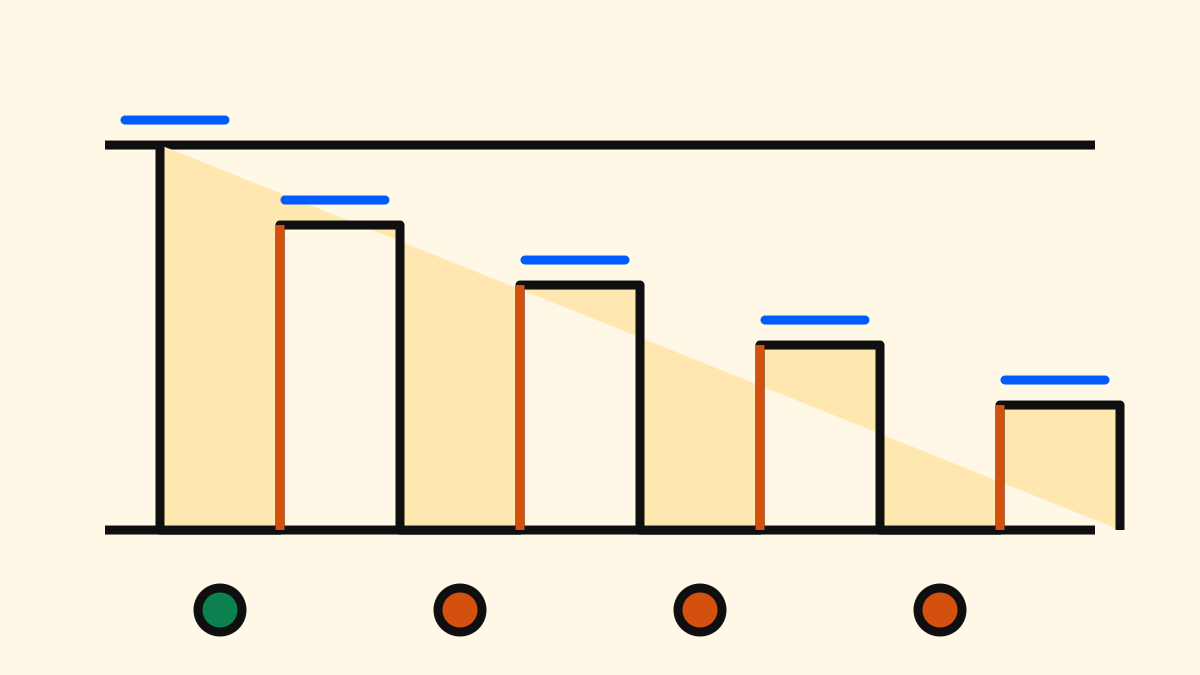
Take a ₹500 biryani, ordered prepaid on a 20 percent discount you're funding, at a 20 percent commission.
- Menu price: ₹500
- Your funded discount (20%): −₹100, so net order value is ₹400
- Commission at 20% of ₹400: −₹80
- GST on that commission at 18%: −₹14.40
- Payment fee at 2% of ₹400: −₹8, plus −₹1.44 GST on it
- TDS at 0.1%: −₹0.40 (adjustable against income tax later)
Settles to about ₹296. That's an effective take of roughly 41 percent of the price you set, before you've paid for the chicken, the rice, the container, or the person who cooked it.
Run the same order with no funded discount and you settle around ₹370, an effective rate of about 26 percent. Same 20 percent headline commission, fifteen points of difference, entirely from the discount decision. That gap is the whole game.
So here's the homework worth doing this week: open last month's settlement statement, divide total settlement by the total menu value of those orders, and meet your real blended rate. Most owners quote their commission from memory and have never once checked that number. If you're not sure how to read the statement, or when the money is even supposed to arrive, start with when Zomato and Swiggy actually pay you and how to check it. Whichever billing software you run should be splitting out aggregator orders from dine-in ones automatically, since this math is where a lot of them quietly fall short.
The platform fee that went up in March 2026 (and isn't yours)
One line on that table causes more confusion than the rest combined, so it is worth separating clearly.
In March 2026 both apps raised their platform fee. Zomato went from ₹12.50 to ₹14.90 per order on 20 March, a 19 percent rise, and Swiggy followed by moving from ₹14.99 to ₹17.58 inclusive of GST, as reported by Medianama. It is a meaningful amount of money: Zomato booked ₹89 crore from platform fees in Q1 FY26, and Swiggy ₹109 crore in additional customer fees over the same quarter.
Here is the part that matters to you: the platform fee is charged to the diner at checkout, not deducted from your settlement. It does not appear in your commission, and it should not appear as a deduction on your payout statement. If you see a lot of confident content saying "Swiggy raised its commission to 17.5 percent in March", that is this consumer-side fee being mistaken for a restaurant-side rate.
That does not make it irrelevant to you. It raises the total the customer pays for the same order, which is one more rupee of price resistance on a basket you are already discounting. But if anyone tells you your commission went up in March 2026, ask them to point at the line on your settlement statement.
The 18% almost nobody budgets for
Commission attracts 18 percent GST. If you're a standalone restaurant on the 5 percent GST scheme without input tax credit, which is most restaurants in India, you cannot claim that 18 percent back. It's a pure cost, roughly 3.6 extra points on a 20 percent commission, and it never appears in the number the sales rep quotes.
Restaurants inside a specified-premises hotel charging 18 percent with ITC can claim it, which changes the math materially. Worth confirming which side of that line you're on; the current GST rates for restaurant food guide covers the rule.
The taxes that are smaller than you think
Plenty of rate cards floating around still list a "1% TCS" line. That's out of date twice over. Since restaurant orders through the apps were brought under Section 9(5) in January 2022, the platform itself pays the 5 percent GST as the deemed supplier, and CBIC's own circular says the operators are no longer required to collect TCS on those orders at all. No TCS line should appear on your settlement for food orders.
Income-tax TDS under Section 194-O does apply, but it was cut to 0.1 percent from October 2024. On a ₹400 order that's forty paise, withheld and adjustable against your income tax. A cash-flow rounding error, not a cost. If a vendor's "aggregator charges" page still shows 1 percent TCS plus 1 percent TDS, the page hasn't been updated in years, and maybe neither has the product.
The dine-in twist: paying to seat your own guests
Delivery commission at least buys you something: reach, logistics, a customer you might never have found. Dine-in is where the logic strains.
Through programs like Zomato Pay and Swiggy Diner, restaurants have reported paying a per-transaction cut of around 4 to 12 percent plus a mandatory diner discount of 15 to 40 percent, against a normal payment gateway charge of just 1 to 1.5 percent. The guest walked into your dining room and sat at your table. You still pay a middleman for the privilege of taking their money.
This is the part the National Restaurant Association of India has pushed back on, and it's why newer entrants like Rapido are pitching 8 to 15 percent commissions to win restaurants over. And the going-out side has its own sheet now that Zomato's dining business lives in District, with its own booking deposits; see how the District cover charge works and, on the other side of the bill, what you're allowed to add as a service charge.
Here's the opinion we'll stand behind. Paying a fifth of the bill to a platform that brought you a new customer is a fair trade. Paying it on a guest who found you, walked in, and sat down is just a tax on your own dining room.
What's actually negotiable in 2026
Honestly: less than you'd like, but more than zero.
Negotiable. Onboarding and imaging fees, routinely waived, especially if you're opening in a locality the platform wants to fill out. Ad spend, entirely yours to switch off. Discount depth and caps, which you set, and can set low. Commission itself, if you bring multiple outlets or you're a cuisine the platform is short of. If you're not listed yet, our guide to registering on Zomato and Swiggy covers the documents and what to push back on.
Not negotiable. GST and TDS. The payment fee. And, in practice, the visibility cost of opting out of Gold or One; nobody writes that down, but your order volume will tell you.
The one lever that consistently moves the number is the boring one: price your aggregator menu 10 to 15 percent above your dine-in menu to absorb the take rate. Nearly every operator who survives on aggregators does this. It isn't gouging; it's pricing a channel at what the channel costs.
What you can actually control
You can't negotiate aggregator commission to zero, and for delivery you may not want to. The reach is real. What you can change is how orders happen inside your own four walls. It is worth seeing what that decision does to the bottom line: on a typical ₹10 lakh month, routing 40 percent of menu value through the apps is roughly the difference between a 9 percent net margin and a small loss, which we work through in restaurant profit margin in India.
We build dineomAI, so treat this section with the appropriate suspicion. But the arithmetic is the arithmetic. Aggregators sell you demand: a customer who didn't know you existed. That can be worth 26 percent. What's not worth 26 percent is the customer already sitting at table 6, whom you acquired yourself, ordering through a channel that takes a fifth of the ticket.
When a guest is at the table, a QR code plus AI chat ordering takes the order directly, in the diner's own language, in their phone browser, on a flat monthly fee with zero commission. The same ₹500 biryani settles at ₹500. It doesn't replace Zomato or Swiggy for delivery; anyone telling you it does hasn't run a restaurant. It removes them from the orders that were always yours to begin with. For the wider picture, see our guide to QR code menu alternatives.
Keeping the whole ₹500 is only half the gain. A channel that takes the order can also grow it, which a billing screen never does: suggest the raita with the biryani, the second round before the table goes quiet. That is the difference between a system that records sales and one that makes them, and it is why average order value is the number worth watching once your commission leak is plugged. If the distinction between the two is fuzzy, we pulled it apart in POS vs ordering system.
FAQ
How much does Zomato charge a restaurant in 2026?
A headline commission of 15 to 30 percent of net order value, most often 18 to 25 percent, with negotiated chain contracts lower. Add 18 percent GST on the commission, a roughly 2 percent payment fee, and any discount you fund, and the effective cost typically lands between 26 and 41 percent of menu price.
Is the Swiggy rate card different from Zomato's?
Not meaningfully. Both sit in the same broad commission band with near-identical fee structures. The differences show up in ad auction pricing by city, membership program mechanics, and whichever onboarding waivers each platform is running that quarter. Judge both by your settlement statement, not the pitch.
Is TCS deducted on Zomato and Swiggy food orders?
No. Since restaurant services came under Section 9(5) in January 2022, the platform pays the 5 percent GST itself as deemed supplier, and CBIC clarified that TCS no longer applies to those orders. Only income-tax TDS under Section 194-O is withheld, at 0.1 percent, and it's adjustable against your income tax.
Can I claim back the GST charged on commission?
Only if you operate with input tax credit, such as a restaurant in a specified-premises hotel charging 18 percent GST. If you pay 5 percent GST on food without ITC, which is most standalone restaurants, the 18 percent GST on commission and fees is an unrecoverable cost.
How do restaurants reduce aggregator commission?
Shrink your dependence, not just the rate. Price the aggregator menu 10 to 15 percent higher to absorb the take, set discounts low and capped, switch off ads that don't pay back, and keep dine-in ordering in-house through your own QR ordering. Every order you take directly is one you keep in full.
Commission is only one line on the settlement. The rest are covered in Zomato payout deductions: what every line means.
What to do next
Pull last month's settlement statement and compute your blended rate: total settlement divided by total menu value. If it starts with a 3 or a 4, your funded discounts, not your commission, are the leak. The same group also wants to supply your kitchen, which is worth reading up on before you consolidate: is Zomato Hyperpure worth it for your restaurant. Then look at your dine-in covers. If a big share of your orders happen at your own tables, take those in-house with a flat-fee QR and AI chat layer, keep the aggregators for delivery, and watch how much of each bill you start keeping. Book a short dineomai demo and run the numbers on your own menu.
See it on a real table
A 15-minute demo: watch dineomAI take an order, speak five Indian languages, and upsell the right pairing. No hard pitch.
Book a 15-minute demo →